
 Red wine
 White wine
 Rosé wine
 Primeurs
 Sherry and Port wine
 Sweet wine
 Orange wine
 Vermouth
 Champagne
 Cava
Cava Prosecco
 Lambrusco
 Crémant
 Moscato d'Asti
 Franciacorta
 Pet-Nat
 Corpinnat
 Other sparkling wines
 Rhum
Rhum Gin
Gin Whisky
 Vodka
Vodka Cognac
 Brandy
 Pastis
 Tequila
 Mezcal
 Grappa and Eau de vie
 Calvados
 Liqueurs
 Pacharán
 Apéritifs
 Wine gift boxes
 Boxed wines
 Boxed sparkling wines
 Wine bottles and glasses
 Gift card
 Non alcoholic Wine
 Non alcoholic Sparkling wine
 Non alcoholic Gin
 Other non-alcoholic drinks
 Aromas
 Wine conservation
 Decanters and aerators
 Bottle identifiers
 Corkscrews
 Service
 Glass identifiers
 Cleaners
 Accessories set
 Wine glasses
 Contact

Unveiling Agustí Torelló Roca, Co-founder and Oenologist of AT Roca
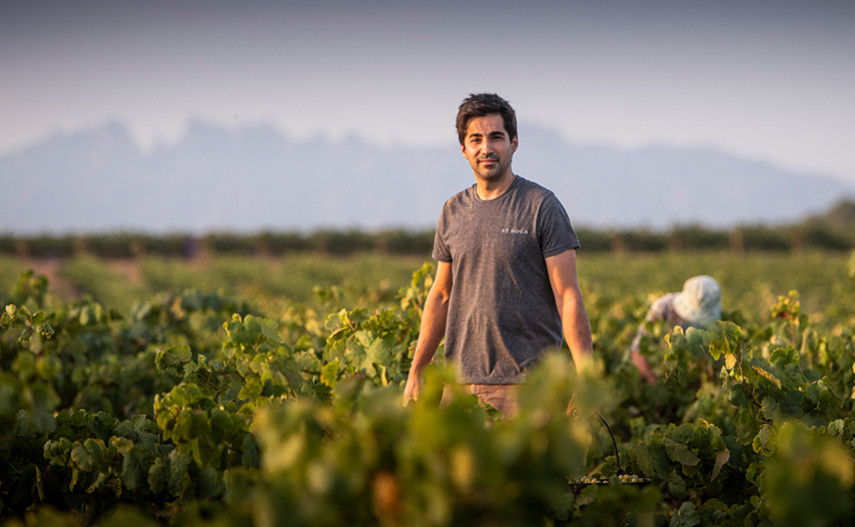
We arrive at AT Roca, and the first thing that captivates us is not the winery itself, but the landscape. Sant Sebastià dels Gorgs is one of those quaint villages in Penedès that seem frozen in time. Vineyards surround it, tranquil paths meander through, and the expansive views silently convey why this place means everything to those who work it. And, since 2023, it has also become the heart of this family's new winery.
Finding the perfect spot to interview Agustí Roca is, paradoxically, a minor dilemma. Not due to a lack of places, but rather an abundance of them. Every corner works; the terrace with the valley in the background, the vineyard itself, the interior of the newly inaugurated winery... Ultimately, we understand that here the setting is not merely a backdrop. It is part of the narrative. Perhaps that is why the conversation flows effortlessly. Agustí Roca speaks of Penedès as one would speak of home, because, in truth, it is.
A Story That Stretches Back
The project of AT Roca was formalised in 2013, but its history is far longer. The family has been entwined with wine for generations. The great-grandparents had very different professions; one was a tailor, the other a musician, but after the post-war period, like many families in the region, they had to reinvent themselves. In that process, sparkling wine became a way of life. “Wine has been consumed at home as a way of life,” Agustí summarises. Not as a distant industry, but as something everyday, present at the table, in celebrations, and in family conversations. “We have lived and endured it. It is part of our DNA.”
Since 2023, the family has taken a significant step by concentrating the entire process in their own winery in Sant Sebastià dels Gorgs. A move that does not alter the essence but rather reinforces it, working from the origin, with the vineyard just a few metres away and the landscape as a constant point of reference.
Wine Begins in the Vineyard
For Agustí Torelló Roca, everything begins before the winery, even before the grape. It begins in the soil. “The soil is a living entity and we want to understand it,” he explains. This perspective defines much of his philosophy. Listening more than imposing, observing more than intervening. The viticulture they advocate revives traditional Mediterranean dry farming practices, adapted to the climate and the natural balance of the vineyard. Pruning, respecting cycles, and the constant reading of each plot are part of a way of working where technique serves the land, not the other way around.
As we converse in front of Els Gorgs, the vineyard stretching just behind where we are seated and which gives its name to the Corpinnat we are tasting, one idea resurfaces repeatedly. Wine only makes sense when it is deeply connected to its origin. Only then can it achieve what great wines do; transport those who drink them.
Penedès: Much More Than a Method
In this way of understanding wine, Penedès is not a denomination or a technique. It is a landscape. “Beyond the vast expanses, there is an enormous variety of plots,” he explains. The valley, open to the Mediterranean and surrounded by mountains, conceals a diversity of soils and microclimates that shatter any notion of homogeneity. Among them, calcium carbonate stands out, a legacy of millions of years beneath the sea, imparting a marked sapidity to the wines of the area.
In this context, a clear statement emerges, without unnecessary nuances: “We have never been cava.” The phrase may surprise, especially in a region historically linked to sparkling wines produced under the D.O. Cava. But it does not reflect a desire for detachment, rather a different way of understanding the identity of wine. From the outset, the family has focused on the origin, the vineyards, and the expression of the land above any commercial category.
This vision connects with Corpinnat, the collective brand created by a group of producers from the heart of Penedès who, after disassociating from the D.O. Cava, opted for more stringent regulations centred on the provenance of the grape, organic cultivation, and complete production on the estate. More than a label, they see it as a way to better organise and explain what they were already doing.
Anima Mundi: The Wine Laboratory
Within the project, there is also a space for exploration: Anima Mundi. Here, minimal intervention wines, pet-nats, and offerings with varieties such as macabeo and xarel·lo are crafted, approached from a freer perspective. It is the place to experiment, take risks, and discover new expressions of the same land. Far from competing with the main winery, Anima Mundi complements it. One consolidates. The other expands.
At AT Roca, wine is not understood as an isolated product, but as a way of interpreting the land. And perhaps that is why, when one sits here with a glass in hand, the feeling is not merely of being in a winery. It is simply of being at home.