
 Red wine
 White wine
 Rosé wine
 Primeurs
 Sherry and Port wine
 Sweet wine
 Orange wine
 Vermouth
 Champagne
 Cava
Cava Prosecco
 Lambrusco
 Crémant
 Moscato d'Asti
 Franciacorta
 Pet-Nat
 Corpinnat
 Other sparkling wines
 Rhum
Rhum Gin
Gin Whisky
 Vodka
Vodka Cognac
 Brandy
 Pastis
 Tequila
 Mezcal
 Grappa and Eau de vie
 Calvados
 Liqueurs
 Pacharán
 Apéritifs
 Wine gift boxes
 Boxed wines
 Boxed sparkling wines
 Wine bottles and glasses
 Gift card
 Non alcoholic Wine
 Non alcoholic Sparkling wine
 Non alcoholic Gin
 Other non-alcoholic drinks
 Aromas
 Wine conservation
 Decanters and aerators
 Bottle identifiers
 Corkscrews
 Service
 Glass identifiers
 Cleaners
 Accessories set
 Wine glasses
 Contact

Interview with Lalo Antón, Managing Director of Artevino Family Wineries
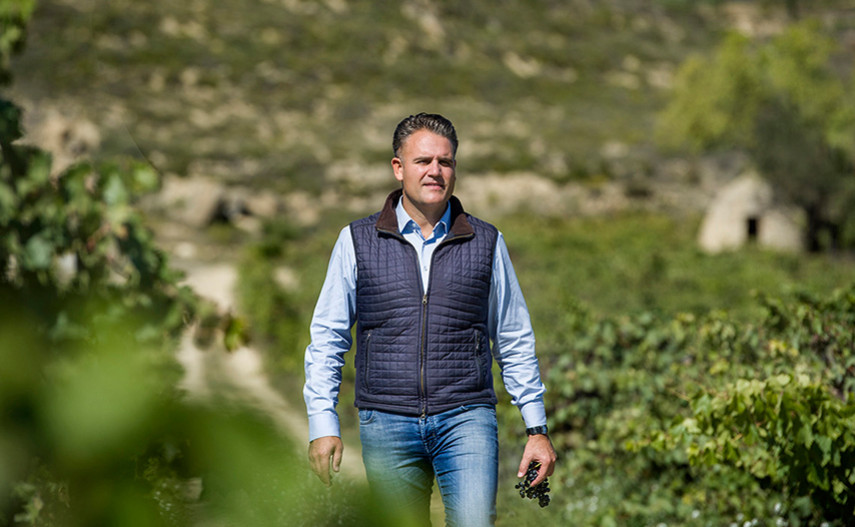
You might not immediately recognise Finca Villacreces, but you will certainly be familiar with Pruno. This is one of the top bestsellers, described by Wine Advocate as one of the finest Spanish wines under $20. Behind this success lies much more than just a label. There is a family story, an estate with its own unique identity, and a very specific approach to wine that is currently led by Lalo Antón.
As a third-generation member of a family deeply rooted in wine and hospitality, Gonzalo Antón—known to all as Lalo—leads the company Artevino with a rare blend of intuition, experience, and an international perspective. He welcomes us at Villacreces, situated in the heart of Ribera del Duero's golden mile, where the landscape is not merely a backdrop but a starting point.
The Setting: A Vineyard Within the Landscape
Upon arrival, the surroundings are striking. A sea of pine trees encircles the estate, buffering the wind, regulating the temperature, and naturally shielding the vineyard. Just a few metres away, the Duero River carves a meander, bringing moisture and life to a territory that seems isolated from the world, yet is profoundly connected to it.
With such a landscape, conducting the interview indoors seems almost impossible. And although the local saying—“eleven months of winter and one of hell”—typical of this elevated plateau with a continental climate, might sound exaggerated, the cold is indeed palpable.
Villacreces is not a typical winery. It is an estate in the most literal sense. Everything revolves around it. Vineyard and winery form a single entity. Here, around 15 plots coexist in a compact space, yet with a surprising diversity of soils: gravel, sand, clay, and loess deposits that, in interaction with the Duero, create a complexity hard to find in such a small area.
The history of the place dates back to the 13th century when a monastery utilised these lands to supply the community. Today, that past remains present, reinterpreted through a contemporary lens.
The Project: From the Pruno Phenomenon to Estate Identity
The success of Pruno came almost unexpectedly. “We weren't Parker's profile,” Lalo admits. However, the wine resonated with a shift in the era where consumers began seeking more fluid, fresh, and gastronomic wines.
And therein lay the key. Because if anything defines Villacreces, it is precisely its culinary vocation. Wines crafted for the table. Not as a concept, but as a natural heritage of a family of hoteliers. Wines with enough structure to accompany food, yet with acidity and freshness to evolve alongside it.
To achieve this, both in the vineyard and the winery, the philosophy is clear: utmost fidelity to origin. The wood should not dominate. Large formats and concrete are used, allowing the wine to breathe without interference. “The wood must be in harmony, not in the foreground,” he summarises.
Commitment: Sustainability as Part of the Legacy
Lalo is certain that the future of wine inevitably involves caring for the environment. All his wineries are certified under the Wineries for Climate Protection programme, a standard that endorses responsible practices in both vineyard and winery.
But beyond certifications, there is a deep conviction that the project does not belong solely to the present. “The legacy must continue, and we must contribute to making that possible”, Lalo explains. This is why vineyard management, efficient resource use, and adaptation to climate change are part of the daily routine. Not as rhetoric, but as a structural necessity. And it is precisely this that is perceived when touring the estate. A way of working that is silent yet steadfast, where respect for the environment is not proclaimed, but practised.
Wine Tourism: From Visiting Wineries to Creating Experiences
Lalo Antón's vision has been refined through travel and contrast. “I've just returned from Argentina, visiting Zuccardi in Valle de Uco. It's inspiring,” he remarks. But if there is one place that has truly shaped his understanding of wine, it is California. There, he discovered something essential: wine tourism is not about showing a winery, but about bringing it to life. From opening doors and displaying barrels to designing complete experiences around wine, landscape, and culture. This paradigm shift translates at Villacreces into initiatives like Día Pruno, a day marking the start of summer in the Golden Mile, attracting a multitude of wine tourists each year. Music, gastronomy, outdoor activities, and wine transform the estate into an open, vibrant space where the experience goes far beyond the glass.
But none of this happens on its own.
Behind it is a team of people who sustain the project day by day. For Lalo, this is the true differentiator: “Without the team, you can't achieve anything. They are part of the project. The challenge is conveying that emotion.” Because at Villacreces, wine is not understood without the people who make it possible. Nor the landscape without those who care for it, nor the experience without those who share it. And it is precisely in this combination—of place, vision, and team—where the project finds its meaning.
In the end, everything returns to the essentials: a glass, a table, a conversation... And the feeling that when wine is well made, it is not just consumed; it is lived.